Garden Play and Crafts
Garden Play and Crafts
Garden play and craft ideas for children: a bean teepee, miniature gardens, painted pots and plant markers, and a sandpit that grows with the family.
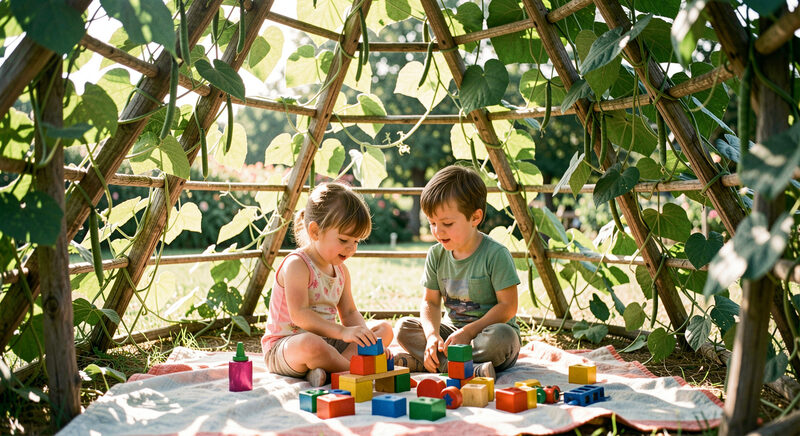
A garden is more than a place to grow food. It is a workshop, a stage and a playground, and the things a child builds there are remembered long after the vegetables are eaten. A den of bean vines, a dish of moss and pebbles, a painted pot on a windowsill, a sandpit dug into a corner: each of these gives a child a reason to be outside and something to return to. This section gathers the projects that turn a family garden into a place to play and make.
Build something that grows
The best garden projects are the ones that change over the season. A bean teepee starts as a frame of poles, becomes a green tower, and ends as a den with a crop of pods hanging inside it. The guide to making a bean teepee sets out the frame, the beans and the sowing, and the same idea can be scaled down to a wigwam of peas for a smaller space. Building something that grows teaches a child that a structure and a plant can be the same thing.
Make the building part of the play. Let the child help push the poles in, tie the top, and choose the gap for the doorway. The den is theirs from the first afternoon, even before the beans have climbed.
Make a small world
A miniature garden is a project a child can carry indoors and keep. A shallow dish, some compost, a few small plants and a handful of props become a scene with a path, a pond and a house. The guide to miniature gardens covers the container, the plants that stay small, and the watering that keeps the scene alive. It is a good project for a wet day, a party or a quiet hour, and it teaches the same lessons as a full bed, only on a scale a child can hold.
Part of the pleasure is that the scene can be remade. When a plant outgrows the dish, lift it and swap it for something smaller. A child who has made three versions of the same garden has learned that a garden is never finished, only tended.
Paint, label and decorate
Painted pots and hand made plant markers make a bed look like a child's own. They are cheap, quick, and useful beyond the making: a labelled row is easier to look after, and a pot a child painted is a pot a child will remember to water. The guide to painting clay pots and making plant markers covers preparing the surface, choosing paint that survives outdoors, and making markers that last a season.
These are good projects for a group, because everyone can make one and the results go into the same garden. Give each child a pot and a marker, and let them choose what to grow in it. A row of painted pots along a step makes a small garden out of a paved space.
Dig, pour and build
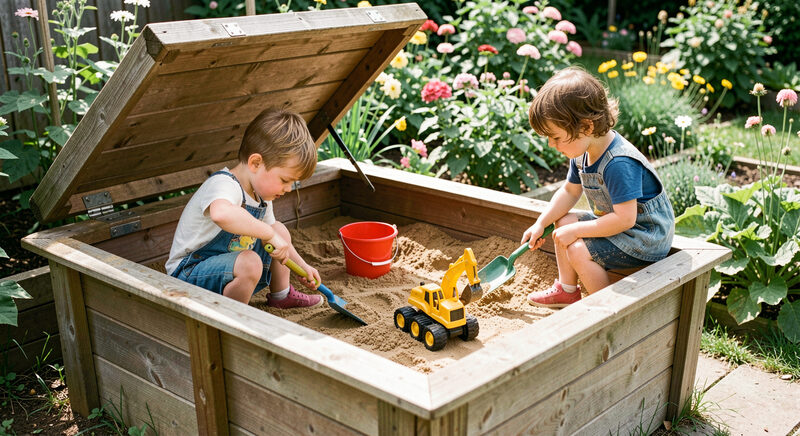
A sandpit holds a child's attention longer than almost anything else in a garden. Sand can be poured, sifted, shaped and dug, and the difference between wet and dry sand is itself a lesson. The guide to choosing and looking after a sandpit covers the spot, the sand to buy, keeping the pit clean and the safety points that matter. A sandpit beside a shallow dish of water, watched by an adult, turns into a whole afternoon of digging and damming.
Sand play also sits naturally beside the other projects in this section. A miniature garden can be built in the sand, a painted pot can be filled beside it, and a bean teepee gives shade nearby on a hot day.
Play that has a purpose
Not every garden activity needs to produce food. A child who builds a den, paints a pot or arranges a tiny landscape is learning to plan, to handle materials and to care for something living. Those skills matter as much as knowing how to sow a seed, and they are the reason a family garden is worth more than the value of its crop.
Keep the projects at the child's scale. Small tools, short sessions and a place to leave half finished work are better than ambitious plans that take a whole weekend. A project that can be picked up again after school will be finished; one that is rushed will be abandoned.
Keeping a kit of materials
Most of these projects run on the same short list of things, and keeping them together in one box saves a hunt every time an idea arrives. The useful contents are a ball of garden twine, a handful of bamboo canes or short sticks, a set of wooden lolly sticks, a small tin of paint and a couple of brushes, a wax pencil or paint pen for markers, a bag of gravel or small pebbles, a few shallow trays and pots, and a notebook and pencil for recording what is made and grown. Add a pair of scissors, a hand trowel and a roll of masking tape, and almost any of the projects in this section can start on the spot.
Keep the box where children can reach it, and let them use it. A kit that is only opened by an adult becomes a chore; a kit that a child can fetch and use makes the garden theirs. Restock it at the end of each season, and put away anything that has rusted or broken. A little order in the box means more afternoons actually spent making something.
Where this section leads
The projects here sit between the growing guides and the care guides. Once something is built, it has to be looked after, and the section on garden care and safety covers the plants to avoid, the slug control that spares wildlife, and the safety checks that let children play freely. The growing guides in growing with children supply the crops that fill the pots, the beds and the teepee. Together, the three sections describe a garden that is grown, made and kept by a family rather than by one adult alone.
Garden Play and Crafts
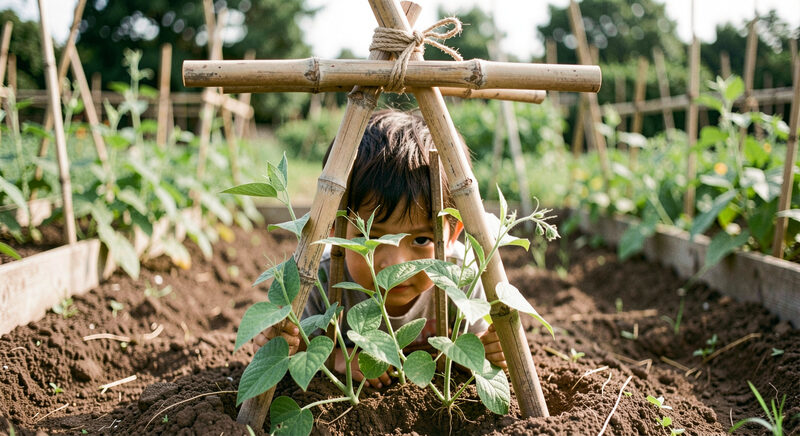
Making a Bean Teepee
Build a living bean teepee with children: choosing poles and climbing beans, setting the frame, sowing at the base and keeping the den growing all summer.
A circle of canes, climbing beans, and a den by midsummer.
Garden Play and Crafts
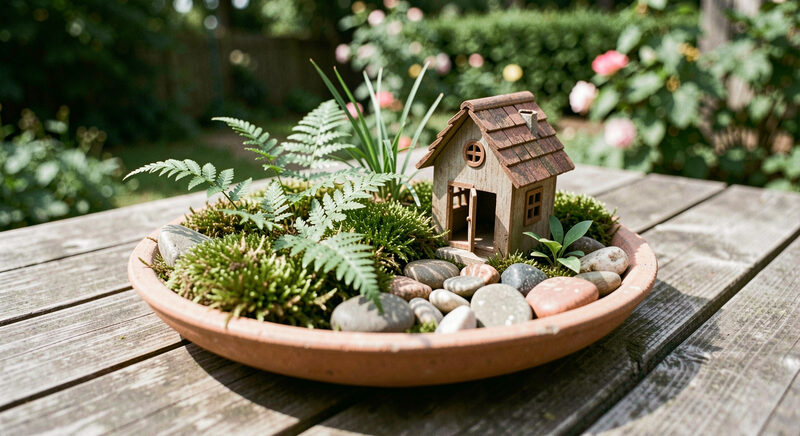
Miniature Gardens
Make a miniature garden with children: choosing a shallow container, soil, small plants and tiny props, and keeping a fairy or dinosaur scene alive outdoors.
A dish, some moss and a few props: a small world a child can keep.
Garden Play and Crafts
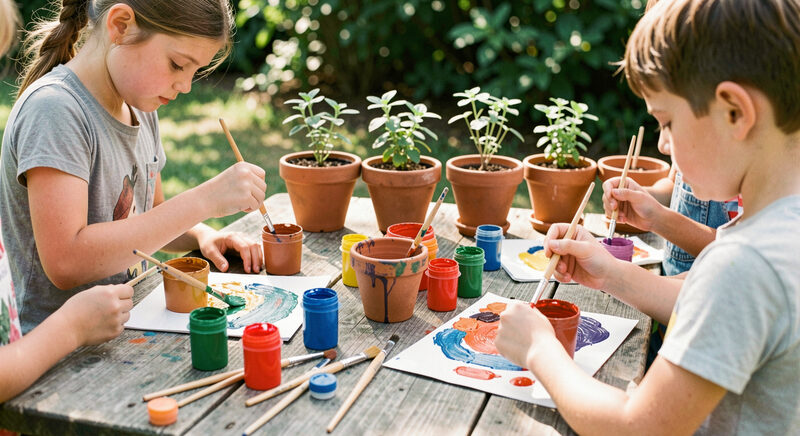
Painting Pots and Plant Markers
Paint terracotta pots and make plant markers with children: preparing the surface, choosing paint that lasts outdoors, and labelling a family vegetable bed.
Pots and markers that survive a season and label the bed.
Garden Play and Crafts
The Sandpit
A sandpit guide for families: choosing a spot and a cover, the sand to buy, keeping it clean and safe, and the play it supports through the seasons.
Choosing the spot and the sand, and keeping the pit clean and safe.