Garden Play and Crafts
The Sandpit
A sandpit guide for families: choosing a spot and a cover, the sand to buy, keeping it clean and safe, and the play it supports through the seasons.
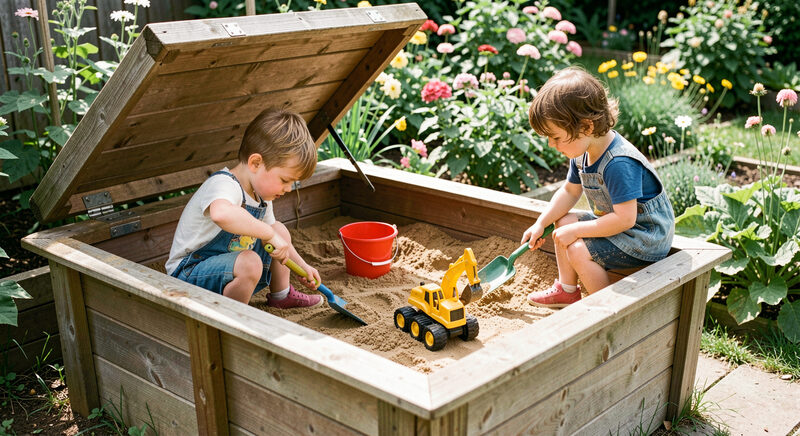
A sandpit is one of the most used pieces of a family garden, and one of the most neglected. It gives children a place to dig, build, pour and dig again, and it holds their attention longer than most toys. But sand that is left uncovered becomes a litter tray for cats, a home for damp and a hiding place for sharp objects. This guide covers choosing a sandpit, the sand to buy, keeping it clean, and the safety points that matter when young children are playing.
Choosing a spot
Put the sandpit where it can be seen from the house and from the kitchen window, so a child can be watched while an adult works. Choose a spot that gets some shade during the middle of the day, because sand in full sun becomes too hot to sit on and a child's skin burns faster than an adult's. Keep it away from a pond, a driveway and a road, and set it on ground that drains, so rain does not leave it sitting in a puddle.
If the garden is small, a sandpit can double as a play table on a patio, or be set into a corner and covered with a lid that becomes a bench. A wooden sandpit with a folding lid is a good compromise: it keeps the sand clean and gives a seat when closed.
The sand to buy
Use play sand, not builder's sand. Play sand is washed and graded, and it is free of the fine dust and sharp grit found in sand sold for building work. Builder's sand can contain silica dust that is not good to breathe, and it is coarser than children's hands expect. Buy enough to fill the pit to a depth of at least fifteen centimetres, which is deep enough to dig and build without reaching the base. A pit a metre square needs about two hundred kilograms of sand to reach that depth.
Sand does not need replacing every year. Top it up as it is carried away in pockets and shoes, and give it a proper clean once or twice a season.
Keeping it clean
Cover the sandpit whenever it is not in use. A lid, a tarpaulin weighted at the edges, or a fine mesh cover all keep out cats, foxes and leaves. Rake the sand before and after play, and remove any debris. Once or twice a year, or more often if the pit is used by many children, wash the sand: tip it into a bucket, add water, stir, pour off the cloudy water and let the sand dry before returning it. Replace sand that smells sour or has become mixed with soil and plant matter.
If an animal has used the pit, remove the soiled sand, wash the rest, and replace what is lost. Keep a small scoop and a covered bin beside the pit for toys, so they are not left out in the rain and do not bring soil into the sand.
Safety points
Sand play is safe when a few simple rules hold. Supervise young children, because sand can be thrown and swallowed. Do not let children eat the sand, and keep very young children from putting handfuls in their mouths. Check the pit for sharp objects, glass and animal mess before each play session, and remove any toys that have broken into sharp pieces.
Keep the pit away from where a lawnmower or a strimmer is used, and cover it while mowing so stones and cuttings do not fly in. Wash hands after play, especially before eating. The wider safety checks for a family garden, including ponds and water butts, are set out in the guide to garden safety.
What sand play gives children
Sand is an open ended material, which is why it holds attention. Children pour, sift, dig, build tunnels, make roads and invent stories, and in doing so they practise hand control, planning and talking about what they are doing. Wet sand can be shaped and dry sand can be poured, and the difference between the two is itself a lesson. Add a few tools, a sieve, a bucket, a small spade and a toy digger, and the play takes care of itself.
Sand also works well alongside other garden play. A sandpit beside a water butt or a shallow dish of water, watched by an adult, turns into a whole afternoon of digging, damming and pouring. The hub on garden play and crafts sets the sandpit beside the bean teepee, the miniature garden and the painted pots as part of a garden built for children.
Making the play richer
Sand is generous on its own, but a few additions turn a pit into a small world. A set of simple tools, a spade, a rake, a sieve, a bucket and a mould, gives children something to do with the material. A toy digger or a set of small vehicles adds a story. A shallow dish of water nearby, watched by an adult, allows digging, damming and pouring, and the wet and dry sand behave so differently that the play keeps renewing itself.
Add natural materials in small amounts: smooth pebbles for a rock pool, shells for a beach, short sticks for a fence. Keep them in a lidded box beside the pit so they can be put away and do not disappear into the sand. Change the props now and then to keep the play fresh, and let the children decide what the pit is that day. A sandpit that is only ever a sandpit is used for a season; one that becomes a beach, a quarry and a castle is used for years.
Looking after the pit through the year
In autumn, clear fallen leaves and cover the pit against the wet. In winter, a covered pit can sit unused, or the sand can be stored in sacks in a dry shed if the pit itself would flood. In spring, rake the sand, top it up and wash it before the season starts. A sandpit that is cleaned and covered will last for years and cost very little to keep going, which is one reason it earns its space in a small garden.