Garden Care and Safety
Organic Slug Control
Control slugs and snails without pellets: barriers, traps, timing and the garden wildlife that eats them, plus what actually protects seedlings and pots.
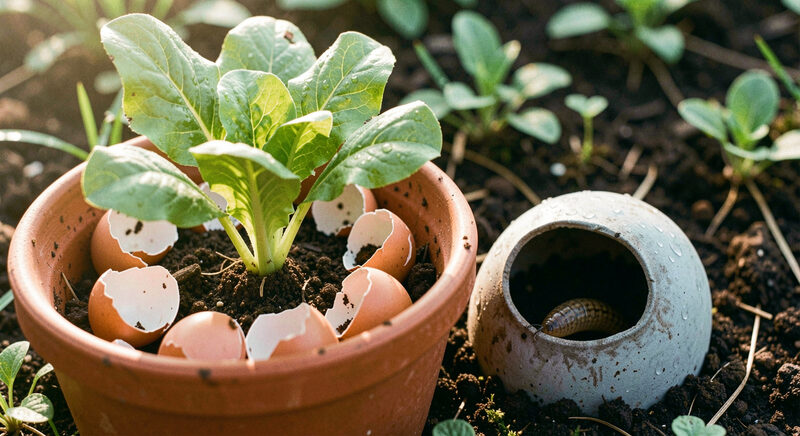
Slugs and snails are the first real enemy a family garden meets. A row of lettuce can vanish overnight, and a tray of seedlings can be cut down in a wet week. The usual answer, blue pellets, is the one thing many families would rather avoid in a garden where children play. The good news is that there are effective ways to protect a crop without them, and some of them are jobs a child can help with.
Know what you are dealing with
Not every slug is a pest. Several species live mostly underground, eating rotting plant matter and helping to break it down, and only a few species do serious damage above ground. Snails are easier to see and easier to catch. The damage is usually easy to recognise: irregular holes in leaves, whole seedlings cut off at soil level, and slime trails in the morning. Damp, mild weather brings them out, and a wet spring is the worst time for young plants.
Barriers that work
A barrier is a physical ring that slugs and snails will not cross, and it works best around a single plant, a pot or a small bed rather than across a whole garden. Crushed eggshell, sharp grit, wood ash, coffee grounds and copper tape are the common choices. Copper tape, fixed around the rim of a pot, is one of the most reliable, because the metal gives a small electric tingle. Crushed eggshell and grit work while they are dry, but rain and soil wash them into the ground, so they need topping up. None of these is perfect, but a barrier around a prized seedling is often enough to get it past the vulnerable stage.
Children can collect and crush eggshells, which is a good use for the kitchen waste, and can help scatter grit around a pot. The barrier is a clear, visible job with a visible result, which makes it a satisfying task for a young gardener.
Traps and night patrols
Slugs and snails come out after dark and after rain, so a torch and a bucket are a simple and effective tool. A late evening walk around the beds will find them on the leaves and on the soil, and they can be collected and moved far away or dealt with. This is the method that does the most good for the least cost, and older children often find it genuinely interesting.
Beer traps are the other classic. Sink a small container into the soil so its rim is just above the surface, half fill it with beer or a sugar and yeast solution, and the slugs will fall in. Empty the trap every day or two, and cover it with a small tile or a piece of slate raised on pebbles, so rain does not dilute it and so birds and pets cannot reach it. Place traps where a child will not knock them over, and wash hands after handling.
Timing and plant choice
The strongest defence is timing. Slugs do most damage to soft, young growth, so raising plants in pots and setting them out once they are larger gives them a much better chance. Sow a spare row as insurance, and plant out more than you need. A lettuce that is already a few centimetres tall can survive an attack that would finish a seedling.
Some plants are far less appealing to slugs than others. Strongly scented herbs, chives, garlic, onions, and plants with hairy or tough leaves tend to be left alone, while lettuce, hostas and young courgettes are favourites. Use the vulnerable crops in pots where they can be protected, and put the tougher ones in the open bed. The guide to easy vegetables to grow notes which of the beginner crops need the most protection.
Encourage the predators
Slugs and snails have natural enemies, and a garden that welcomes them does part of the work. Frogs, toads, hedgehogs, ground beetles, centipedes, slow worms and many birds all eat slugs or their eggs. A small wildlife pond with a gentle edge, a log pile, a patch of long grass and a few dense shrubs give these creatures somewhere to live. A garden with a healthy population of frogs and beetles will have fewer slugs, not because the slugs are killed outright but because their numbers stay in check.
Encouraging predators is slower than a pellet, but it is permanent and it adds interest to the garden. The guide to making a wildlife garden explains how to build the log pile and the water dish that bring these helpers in. A child who has watched a frog in the long grass has a reason to leave the slugs to it.
What to do when a crop is lost
Some losses are part of gardening. If a whole row goes, clear it, improve the protection around the next sowing, and try again. Keep a note of what was eaten and what survived, because the pattern repeats. A bed that is regularly stripped may be too damp, too shaded, or too close to a hedge where the slugs shelter, and moving the crop or improving the drainage can solve more than any barrier.
For a family garden, the goal is not a slug free plot but a fair share of the crop. Protect the seedlings, collect a few on a night patrol, welcome the frogs, and accept that the garden belongs to more than one species. That is a lesson worth passing on, and the hub on garden care and safety places it beside the other work of keeping a garden healthy.